
Beyond the cycle of success and failure
Research has repeatedly shown me how far effort can be from a clear result. Many attempts do not work out as expected. Over time, even the confidence to try again can suffer. I began to wonder: why do some people become increasingly successful, while others gradually lose the ability to change their circumstances after repeated setbacks?
In human society, the confidence that “I can do this” often takes a succession of successes to build, yet a few major failures may undo it. This asymmetry between building and losing confidence makes cycles of failure easier to enter and cycles of success harder to establish and sustain. The resources and opportunities that success brings can widen this gap further.
We often attribute persistence to willpower, but everyone has limits. Even someone who has been resilient and successful can be overwhelmed by later setbacks. In my view, placing all hope of overcoming adversity in personal willpower or past success, while overlooking a person’s circumstances and available support, places too much faith in the power of the mind and falls short of an adequate scientific methodology.
A paper that gave me inspiration was by Zhou and colleagues in Science: History of winning remodels thalamo-PFC circuit to reinforce social dominance (2017). Under experimental conditions, repeated wins strengthened connections in a particular brain circuit in mice, helping them maintain an advantage in later contests. Put simply, winning left a trace in the brain that affected how they competed next.
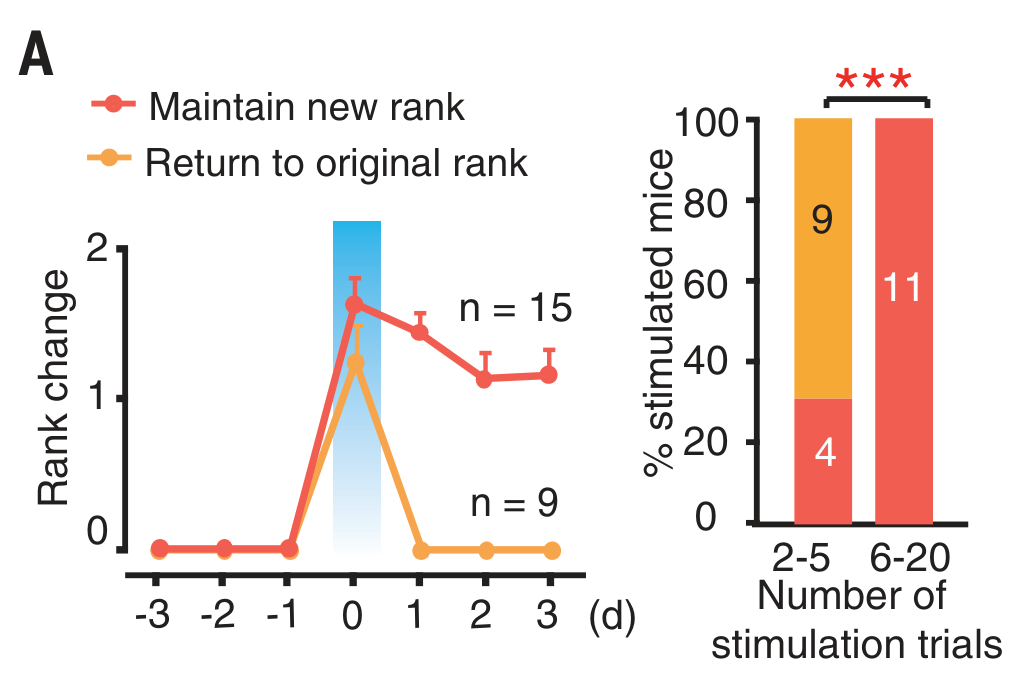
Another finding in the paper stayed with me: artificially activating the relevant brain region made previously subordinate mice compete more actively and even defeat opponents that had previously beaten them. In this experiment, their past record did not fully determine their later performance. I want to keep asking: could we find an approach that helps people take the actions a successful person would take, even after failure?
A purely imagined victory cannot solve this problem either. In Lu Xun’s The True Story of Ah Q, Ah Q can recast defeat as victory in his mind and find temporary comfort, while his actual circumstances remain unchanged. If that explanation encourages avoidance or disregard for feedback, change may become harder. Comfort can offer a moment to recover; it cannot replace the judgment and action needed to address a problem.
I want to spend my life looking for a more fundamental approach: one that helps people with different personalities and histories of success and failure sustain the ability to face reality, take the actions a successful person would take, and gradually improve their lives, with as little dependence as possible on exceptional willpower or endurance.
AI is changing work and may unsettle the ways many people earn a living, gain recognition, and understand who they are. When skills built over many years are no longer needed, how can a person understand their own value and find a direction in which to act? The urgency of this question extends far beyond my own life. It concerns growing numbers of people, and how humanity will live through these changes.
For me, this is also part of what pursuing a Doctor of Philosophy means: taking an important question seriously without restricting the search for answers to a single discipline. I hope to bring a different perspective through what I have learned about artificial intelligence, memory, and learning.